
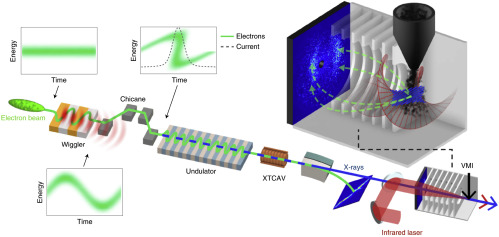

Free-Electron Lasers (FELs) are attracting growing attention as candidates to power the next generation of Extreme Ultraviolet (EUV) lithography. Their promise lies in delivering high power, tunable wavelengths, and continuous operation, all qualities that address the limitations of Laser-Produced Plasma (LPP) sources. Yet the same physics that makes FELs so powerful also introduces new challenges. Higher-order harmonics, bandwidth control, and coherence tuning must be managed carefully to ensure the light delivered is both stable and usable for advanced lithography. Erik Hosler, a researcher focused on next-generation lithography, underscores that solving these challenges will be essential if FELs are to move from research into production. His perspective highlights the reality that technical promise must always align with manufacturing practicality.
At the heart of FEL innovation is the balance between raw capability and controlled precision. Semiconductor fabs cannot simply accept higher power. They require stable, consistent EUV light tailored to patterning needs at the most advanced nodes. Mitigating harmonics, narrowing bandwidth, and tuning coherence are not secondary considerations but central requirements for practical deployment. These engineering efforts ensure that FELs will not just produce EUV radiation, but produce the right kind of radiation for wafer-scale manufacturing.
The Challenge of Higher Harmonics
When electrons pass through an FEL’s undulator, they emit not only the desired fundamental wavelength but also higher-order harmonics. These harmonics can interfere with lithography by introducing unwanted energy that impacts photoresist performance and wafer pattern fidelity. Left unmanaged, they can reduce yield and complicate downstream processes.
Harmonics also affect the delicate chemistry of photoresists. Even lesser amounts of higher-frequency radiation can trigger unintended reactions, leading to line-edge roughness or variations in resist sensitivity. It creates inconsistencies that directly reduce wafer yield, particularly at the most advanced nodes, where tolerances are razor-thin. In LPP systems, mirror contamination poses similar risks, but in FELs, harmonics must be controlled with equal rigor. By addressing harmonics proactively, engineers can ensure that FEL-generated EUV light improves, rather than complicates, manufacturing outcomes.
Designing undulators with precise magnetic field control is one way to suppress higher harmonics. Specialized insertion devices, harmonic filters, and advanced beamline optics are also under consideration. By attenuating or redirecting harmonics, engineers can preserve the purity of the EUV output. The goal is not only to maximize power but to ensure that power translates into useful, controlled illumination for semiconductor patterning.
Bandwidth Control in FEL Systems
Unlike LPP systems, which produce relatively broad emission spectra, FELs can generate extremely narrow bandwidths. For lithography, this is both a strength and a challenge. Too broad a bandwidth risks introducing stochastic variation in exposure, while an overly narrow spectrum can limit flexibility in matching photoresist responses.
To address this, engineers are exploring advanced seeding techniques. High-Gain Harmonic Generation (HGHG) and self-seeding approaches allow FELs to produce radiation with improved spectral purity and narrower bandwidth control. These methods refine the electron beam interaction with the undulator, stabilizing the emitted wavelength over long runs. For lithography, such control means fabs can align EUV light precisely with resist requirements, improving line fidelity and reducing variability across wafers.
Bandwidth control strategies also focus on adjusting undulator parameters and integrating monochromators in the beamline. These approaches allow engineers to fine-tune output to match lithographic requirements. By carefully balancing bandwidth, FEL systems can optimize both throughput and precision, ensuring wafers are exposed under conditions that maximize yield.
Coherence Tuning for Pattern Fidelity
Coherence is one of FEL’s defining advantages, enabling highly stable and precise radiation. However, excessive coherence can lead to interference patterns and speckle effects that reduce uniformity on the wafer. Lithography requires controlled coherence levels that provide consistency without introducing artifacts.
Tuning coherence involves both electron beam preparation and optical manipulation. Adjustments in injector design, undulator settings, and beam transport systems allow engineers to dial coherence to the desired level. This flexibility makes FELs uniquely adaptable to semiconductor needs, where the goal is not theoretical perfection but practical usability. Coherence tuning thus becomes a central design objective, ensuring FEL output translates effectively into lithography performance.
Integrating Harmonic and Coherence Control into Fab Workflows
For FELs to succeed in semiconductor fabs, harmonic suppression, bandwidth narrowing, and coherence tuning must be automated and reliable. Fabs cannot afford frequent manual recalibration or interruptions. Control systems must therefore be integrated directly into operational workflows, providing continuous monitoring and adjustment.
Predictive calibration is an emerging area of interest. By using machine learning algorithms and adaptive optics, fabs could automatically anticipate and correct deviations in harmonic content or coherence before they impact wafer exposure. This proactive approach transforms light quality control from a reactive process into a seamless part of fab operations. Real-time feedback systems further strengthen this integration, with sensors tracking spectral purity, coherence levels, and harmonic content, feeding into automated correction protocols. By embedding these capabilities into fab architecture, FELs can provide EUV light that meets lithography specifications consistently, without introducing operational bottlenecks.
Industry Perspectives on Light Quality
Within the semiconductor industry, discussions about FELs increasingly focus on whether they can deliver EUV light that is not just powerful but also clean and controllable. Meeting fab requirements goes beyond generating raw intensity because it requires precision engineering that aligns with lithographic needs.
Erik Hosler remarks, “Patterning techniques developed for advanced EUV… might be needed in a photon-based quantum computer.” While referring to broader applications, his insight applies directly to FEL adoption, including advanced control of light quality will be essential not only for new computing paradigms but also for sustaining lithography. For FABs, it means that breakthroughs in harmonic mitigation and coherence tuning will directly influence whether FELs are judged viable for production-scale deployment. His statement underscores the link between precise patterning and the viability of emerging technologies.
Toward Precision-Engineered FEL Light
The future of FEL adoption in EUV lithography depends on mastering the balance between power and precision. Suppressing higher harmonics, controlling bandwidth, and tuning coherence are central to ensuring that FEL output aligns with fab requirements. Without these capabilities, even the most powerful FEL systems would struggle to deliver practical value.
Progress in harmonic mitigation and coherence control will determine whether FELs become the cornerstone of semiconductor scaling. These efforts reflect that lithography is defined not just by how much light is generated but by how precisely that light is controlled. By engineering FELs for precision and power, the semiconductor industry can unlock a new era of high-performance manufacturing, ensuring that EUV remains viable as nodes shrink further.
– Where Every Gardener’s Dream Comes True!