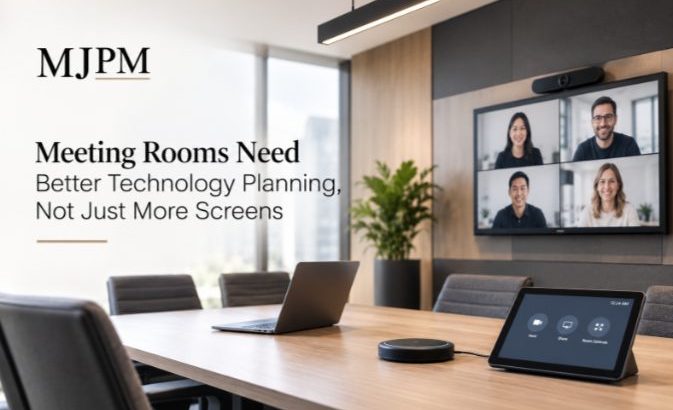
Meeting rooms are often judged by their appearance first: a generous table, a polished screen wall, a considered material palette. Yet the moment a call begins, the real test is much more practical. Can everyone be heard? Is the camera positioned naturally? Can a colleague join without asking for cables or help from IT? A well-designed meeting room should make those questions almost invisible.
Hybrid working has raised the standard. A room may host people sitting around a table while others join from different cities or time zones. If the sound is uneven, the screen is too small or the controls are confusing, remote participants quickly become observers rather than contributors. The result is not only a frustrating call; it is a meeting format that quietly favours whoever happens to be in the room.
Technology planning should therefore begin before furniture is selected. The size of the room, the expected number of users and the types of meetings it will host all shape the specification. A compact huddle room may only need a simple display, camera and reliable wireless sharing. A client-facing boardroom may require more considered audio coverage, integrated controls, display placement and a lighting scheme that supports both in-person discussion and video presentation.
The best solutions are usually the ones that feel intuitive. That means considering small details that are easy to overlook during a fit-out: where devices connect, how cables are managed, whether a presenter can see remote participants clearly, and how people enter a meeting without disrupting it. The room should work for a first-time visitor as smoothly as it works for the team that uses it every day.
Design also plays a role in technology performance. Hard finishes may look impressive but can create a harsh acoustic environment if they are not balanced with absorptive materials. Light from windows, decorative fittings and screens needs to be coordinated so faces remain clear on camera. Even the depth of a table can affect how comfortable people feel when looking at a display or speaking to a camera. These are not separate design and IT decisions; they are one experience.
For organisations with several room types, consistency is especially valuable. If every space uses a different control system or connection method, staff lose time at the start of every meeting. A clear room hierarchy, with familiar interaction patterns, makes the office easier to use and reduces the need for ad hoc technical support.
A thoughtful workplace partner can coordinate these considerations early enough to avoid last-minute compromises. MJPM brings interior design and practical delivery together, helping businesses create meeting environments that reflect how teams now communicate. Explore MJPM’s wider workplace design work, or read its meeting room AV system design guide for a more detailed view of the decisions that make hybrid meetings run smoothly.