
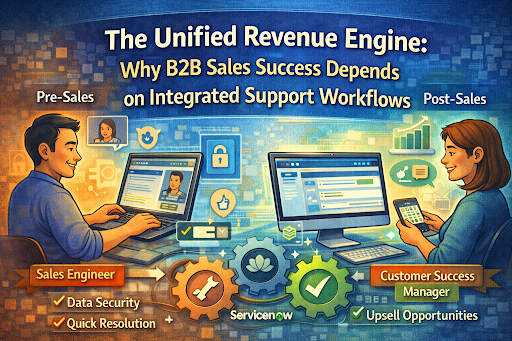
In the modern enterprise landscape, the traditional “hand-off” between Sales and Support is no longer a clean break. It is a critical transition point that can either solidify a partnership or trigger immediate buyer’s remorse.
For years, organizations have operated in silos: Sales focused on acquisition, and Support focused on ticket resolution. However, as the B2B marketplace shifts toward subscription models and “Success-as-a-Service,” this fragmentation has become a significant liability.
To stay competitive, organizations must view their technical infrastructure not just as a set of tools, but as a cohesive “Revenue Engine.” By aligning the principles of B2B sales with high-efficiency platforms, companies can turn technical excellence into their strongest selling point.
Redefining the B2B Sales Cycle in the Modern Era
To understand why support integration is vital, we must first look at the unique nature of the B2B sales process.
Unlike B2C transactions, which are often emotional and instantaneous, B2B sales are characterized by high stakes, multiple decision-makers, and long-term risk assessment.
As outlined in a comprehensive guide to B2B sales, the process is a marathon, not a sprint. It requires a deep understanding of the prospect’s pain points and a strategic approach to lead nurturing. In this environment, a “sale” is actually a promise of future value.
When a B2B buyer signs a contract, they aren’t just buying a software license; they are buying into your company’s ability to solve their problems over the next three to five years. If the first interaction they have post-sale (onboarding or technical setup) is disjointed, you have effectively failed to deliver on the very first promise made during the sales cycle.
The High Cost of “Context Switching”
One of the biggest silent killers of B2B growth is friction. Specifically, the friction experienced by both the customer and the internal team when jumping between disconnected platforms.
Imagine a scenario where a Sales Engineer is trying to help a high-value prospect with a complex ServiceNow implementation. If the engineer has to stop the conversation to send a separate link for a third-party meeting tool, wait for the prospect to download a plugin, and then manually log the notes of that meeting back into the CRM, several things happen:
- Momentum is lost: Every “click” or “download” required by a prospect is an opportunity for them to disengage.
- Data Gaps: Important technical context discussed during the call often fails to make it back into the system of record.
- Security Risks: Using unauthorized or “shadow IT” tools to facilitate screen sharing can trigger red flags for the prospect’s IT security team.
The Power of Platform-Native Solutions
For organizations that rely on ServiceNow as their primary engine for workflow automation, the goal should be “Zero Friction.” This means keeping the agent, the salesperson, and the customer within a single, trusted environment.
This is where the concept of platform-native integration becomes a competitive advantage. Using a ServiceNow-integrated solution allows teams to launch co-browsing, remote support, or live video sessions directly from a ServiceNow case, incident, or lead record.
Why “Native” Matters for B2B Growth
- Security & Compliance: In B2B sales, security is a feature. When your support tools are embedded within your ISO-compliant or SOC2-compliant platform (like ServiceNow), you bypass the security hurdles that often stall enterprise deals.
- Data-Driven Upselling: When every technical interaction is logged within the same platform your sales team uses, the sales team can see exactly where a customer is struggling. If a customer frequently requests support for a specific module, that is a prime signal for a training upsell or a specialized product expansion.
- Reduced Time-to-Resolution (TTR): In B2B, time is literally money. A faster resolution to a technical roadblock during the trial phase can shorten the sales cycle by weeks.
Bridging the Gap Between “Pre-Sales” and “Post-Sales”
The most successful B2B companies are those that realize the “Sales Engineer” and the “Customer Success Manager” are two sides of the same coin. Both roles require high-touch technical interaction.
The Sales Engineer’s Perspective
During the pre-sales phase, a Sales Engineer often needs to “walk” a prospect through a complex configuration. If they can do this via cobrowsing—where they can see the prospect’s screen and guide them in real-time without taking control away—the prospect feels empowered. It transforms a “demo” into a collaborative working session.
The Support Agent’s Perspective
Once the deal is closed, the support agent takes over. If they have access to the exact same tools and the historical data from the pre-sales demos, the transition is invisible to the customer. The customer doesn’t have to repeat their problems or re-explain their architecture. This continuity is the hallmark of a world-class B2B organization.
Metrics That Matter: Moving Beyond Ticket Volume
To measure the success of this integrated approach, B2B leaders must look at more than just how many support tickets were closed. They need to track:
- Expansion Revenue: Is the integration of sales and support data leading to more cross-sell and upsell opportunities?
- Net Promoter Score (NPS) by Account: How does the technical support experience correlate with the overall satisfaction of the decision-makers?
- Customer Acquisition Cost (CAC) Payback Period: Does faster, integrated onboarding lead to a quicker realization of value for the client?
Conclusion: The Future is Integrated
The “Great Divide” between Sales and Support is a relic of an era when software was sold in a box and support was a cost center. In today’s cloud-first, relationship-driven B2B economy, your technical support capabilities are your most effective sales tool.
By leveraging the insights of a robust B2B sales strategy and empowering your team with native ServiceNow tools, you create a frictionless experience that delights prospects and retains clients for the long haul. Stop thinking of support as a way to fix problems, and start thinking of it as the ultimate way to prove your value every single day.
– Where Every Gardener’s Dream Comes True!