

| TL;DR Dimensional weight is (L × W × H) ÷ 139. An 18 × 14 × 4 box holding a 1 lb product bills as 7.25 lb.That single error nearly doubles the fulfillment fee, from about $3.50 to over $6.00.Six inputs drive the whole model, and the two people get wrong are packaged weight and packaged dimensions.Source against 25%+ margin, not the 15 to 20% you want to end up with, because the gap is what absorbs your mistakes. Short version: the calculator is not the hard part. Feeding it the box you will actually ship, rather than the product your supplier described, is the hard part. |
A one-pound product is not a one-pound shipment. Put it in an 18 by 14 by 4 inch box and Amazon bills it as 7.25 pounds, because dimensional weight is length times width times height divided by 139, and 1,008 divided by 139 is 7.25.
The fee consequence is not marginal. On actual weight the fulfillment fee is around $3.50. On dimensional weight it is over $6.00, close to double, on a box that still sits inside the large standard tier. Nothing about the product changed. Somebody chose a box.
The full input checklist and the calculation sequence are set out in this guide to the Amazon FBA calculator.
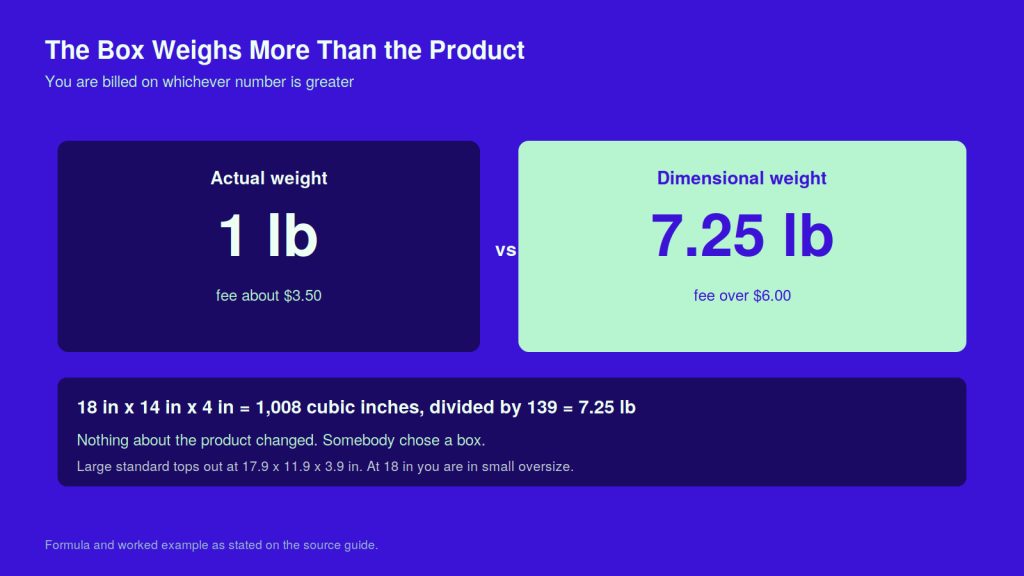
Same product, two billable weights. The larger one wins.
Six Inputs, Two of Which Get Fabricated
The model needs packaged dimensions, packaged weight, category, selling price, cost of goods, and inbound shipping. Four of those you know. Two you tend to guess.
Packaged dimensions and packaged weight are the ones. The failure mode is specific and almost universal: the seller enters the figures from the supplier’s spec sheet, which describe the product, not the retail-ready unit with its box, insert, poly bag and label.
The correct method is to have one finished unit in front of you and measure it. Not the sample without packaging, and not the number in the quote. A quarter inch on the longest side can push a unit into the next size tier, and the tiers are cliffs rather than slopes: large standard runs to 18 by 14 by 8 inches and 20 pounds, and anything beyond that is in a bulky tier with a different fee schedule.
Category matters too, and it is the input people enter once and never revisit. Referral fees run 8% to 45% across the catalog. Home and kitchen sits at 15%, electronics at 8% with a $0.30 minimum, clothing and accessories up to 17%.
Watch One Product Move
The destination page runs a kitchen gadget, 15 by 10 by 4 inches at 2.5 pounds, sold at $24.99, with $5.00 of cost of goods and $0.80 of inbound shipping. It reports a net of $7.46 at a 29.85% margin.
The useful part is not that number, and it is worth saying why. Add up the components the page lists and you land 27 cents away from its own total, so treat the base figure as indicative rather than as a decomposition you can audit. What is exact, and what actually matters, is what happens when you move one input.
| Change | Net profit | Margin |
| Base at $24.99 | $7.46 | 29.85% |
| Price down to $19.99 | $3.21 | 16.06% |
| Price up to $29.99 | $11.71 | 39.05% |
| COGS negotiated to $4.50 | $7.96 | 31.85% |
Two things fall out of that table.
A $5.00 price change moves net profit by $4.25, not $5.00, because the referral fee takes 15% of the difference. Every other cost holds flat. So price is the highest-leverage input in the model by a wide margin, and it is also the one most sellers treat as fixed by the market.
And fifty cents off the unit cost is worth fifty cents of net profit, every cent of it. Supplier negotiation goes straight to the bottom line in a way price changes do not, which is why an hour on the cost quote often beats a week on the listing.
The Cost the Checklist Leaves Out
One input belongs in a sourcing model and is missing from most of them, because it is not a marketplace fee.
If you are importing a consumer product that is subject to a CPSC safety rule, certification is your obligation as the importer. Not every import is caught, and the qualifier is doing real work: the Consumer Product Safety Commission requires importers of general-use products “subject to a consumer product safety rule, or a similar rule, ban, standard or regulation” to certify compliance in a written General Certificate of Conformity, based on testing or a reasonable testing program.
Where it does apply, the regulation is explicit about who carries it. 16 CFR § 1110.7 provides that, except as a specific rule says otherwise, for a finished product manufactured outside the United States “the importer, as defined in this part, is the finished product certifier that must issue a finished product certificate.” Not the factory. You.
Two practical consequences for the calculator. Testing costs money and it is a real per-unit cost at low volumes, particularly for children’s products, where certification requires results from a third-party CPSC-accepted laboratory rather than the reasonable testing program that suffices for general-use goods. And under a rule revised in January 2025, with the requirement operative from July 2026, certificate data must be filed electronically at the time of entry, which is a process step and a broker cost rather than a form you keep in a drawer.
None of that appears in a fee calculator. All of it appears in your bank account.
Returns Are a Line, Not a Surprise
The other systematic omission is returns, and the allowance depends heavily on what you sell.
A general working allowance is 3 to 5% of revenue. Apparel can exceed 15%. Electronics runs around 5%. Entering zero, which is the default because the field is often blank, produces a model that is optimistic by exactly the amount that will eventually hurt.
Source Against the Higher Number
The two margin figures in this article are doing different jobs and it is worth being explicit about which is which.
A net margin of at least 15 to 20% is what a healthy product looks like once it is running. But sourcing decisions should be made against 25% or better, and the gap between those two numbers is not conservatism. It is the space that absorbs the fee increase in January, the packaging change in March, and the return rate that turns out to be higher than the category average.
A product that models at exactly 15% before you have bought any of it is a product that will be unprofitable within a year, and you will have a container of it.
Re-Run It When the Box Changes
The last discipline is a trigger rather than a schedule.
Any time the packaging changes, re-run the model. A new insert, a slightly deeper carton, a bundled accessory: all of them can move a size tier, and a size tier moves the fulfillment fee by dollars per unit while the product itself looks identical.
Sellers who get caught by this are rarely careless. They calculated correctly, once, against a box that no longer exists.