
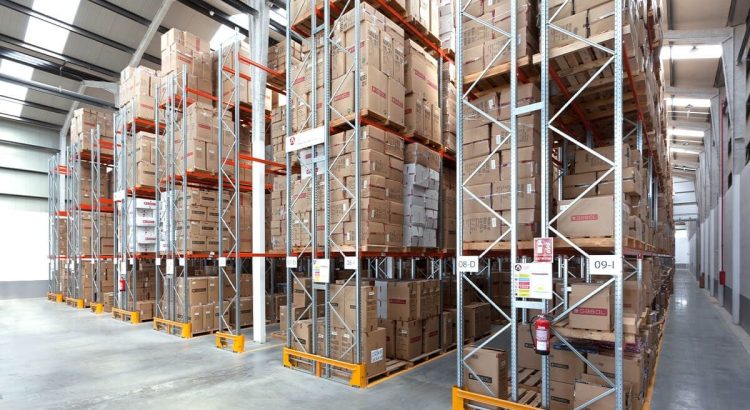
Factories and warehouses want different things from storage. A distribution warehouse optimises for pick rate across many SKUs. A factory stores raw material at the point of use, work in progress between processes, finished goods before despatch, and tooling that must be retrievable in minutes. Choosing among industrial racking options for factories and warehouses means matching each system to the specific job it does rather than picking one and applying it everywhere.
Selective Pallet Racking
The most widely used system and the correct default. Every pallet faces an aisle, so any SKU is reachable at any moment without relocating anything else. It is inexpensive per pallet position, simple to reconfigure as beam levels are repositioned, and compatible with any forklift. Its weakness is density, since aisles consume a large share of floor area. For operations with many SKUs and few pallets each, that inefficiency is more than repaid in handling time.
Double Deep Racking
Storing pallets two deep halves the number of aisles and lifts density meaningfully, at the price of accessibility, the rear pallet cannot be reached until the front one moves. It requires a reach truck with telescopic forks and an operator comfortable placing loads blind. It suits operations with at least two pallets of each SKU and tolerance for a small amount of double handling, and it suits them very well.
Drive-In and Drive-Through
Here the aisles disappear entirely and the forklift enters the structure, placing pallets on rails within lanes. Density is the highest of any static system. The trade is severe restriction on selectivity, since drive-in operates last-in, first-out and drive-through requires access from both ends to achieve first-in, first-out. It fits cold storage, bulk raw material and seasonal stock with few SKUs and high volume. It fits a diversifying product range badly.
Cantilever Racking
For anything long, pipe, timber, extruded sections, steel bar, sheet material and panels. Loads sit on arms projecting from a central column, leaving the full length unobstructed for loading. Design questions are arm length and capacity, arm spacing relative to how much the material sags between supports, and base sizing to resist the overturning force when only one side is loaded. Factories handling raw stock in long formats need this rather than an adaptation of pallet racking.
Long Span and Shelving
Where items are hand-picked rather than moved by forklift, beam racking with shelf panels or dedicated long span shelving gives a workable picking face. This suits spare parts, consumables, tooling, packaging materials and anything counted in boxes rather than pallets. Combining a hand-pick level at floor height with pallet storage above is a common and effective arrangement, keeping bulk and picking stock in the same footprint.
Mezzanines and Multi-Tier Structures
Where headroom exceeds what racking uses, a mezzanine converts air into floor. In a market where industrial space is expensive this is frequently the highest-return option available. It also introduces staircases, edge protection, load ratings, egress routes and fire protection considerations, so a mezzanine is a designed structure requiring submission and approval rather than a large shelf.
Mobile and Automated Systems
Racking mounted on powered bases that move along floor rails removes all but one aisle, and can nearly double capacity within the same footprint. Costs are considerably higher, the floor requirements are demanding, and retrieval is slower because a bank has to open before a pallet is reached. It suits archives, cold rooms and high-value storage where space is scarce and access frequency is low. Suppliers offering the full range of industrial racking in Singapore will tell you honestly when the numbers do not justify it.
Pallet Live and Carton Flow
Where throughput is high and stock rotation must be strict, gravity systems earn their cost. Pallet live storage places loads on inclined roller lanes so they travel from a loading face to a picking face under their own weight, giving first-in, first-out automatically and separating the two traffic flows. Carton flow does the same at case level for hand picking, presenting stock at the front as each item is removed. Both require careful specification of lane gradient, roller spacing and braking for the load weight involved, and both reward operations with consistent unit sizes rather than variable ones.
Factory-Specific Requirements
Production environments add constraints that a distribution warehouse does not have. Storage sits close to machinery, so access routes and clearances matter. Work in progress needs buffer storage between processes, often at partial pallet quantities. Tooling and moulds are heavy, awkward and needed at short notice, which argues for selectivity over density regardless of how little each item moves. And housekeeping is harder around production, so impact protection deserves more attention rather than less.
Choosing the Combination
Very few facilities are best served by a single system. A typical arrangement uses selective racking for the bulk of SKUs, a density system for the few high-volume lines, cantilever for long goods, shelving or a mezzanine for hand-picked items, and a defined unracked area for staging. Work out the pallet profile and movement frequency of each category first, then assign a system to each. Approached that way, industrial racking options for factories and warehouses stop competing with one another and start dividing the work sensibly.